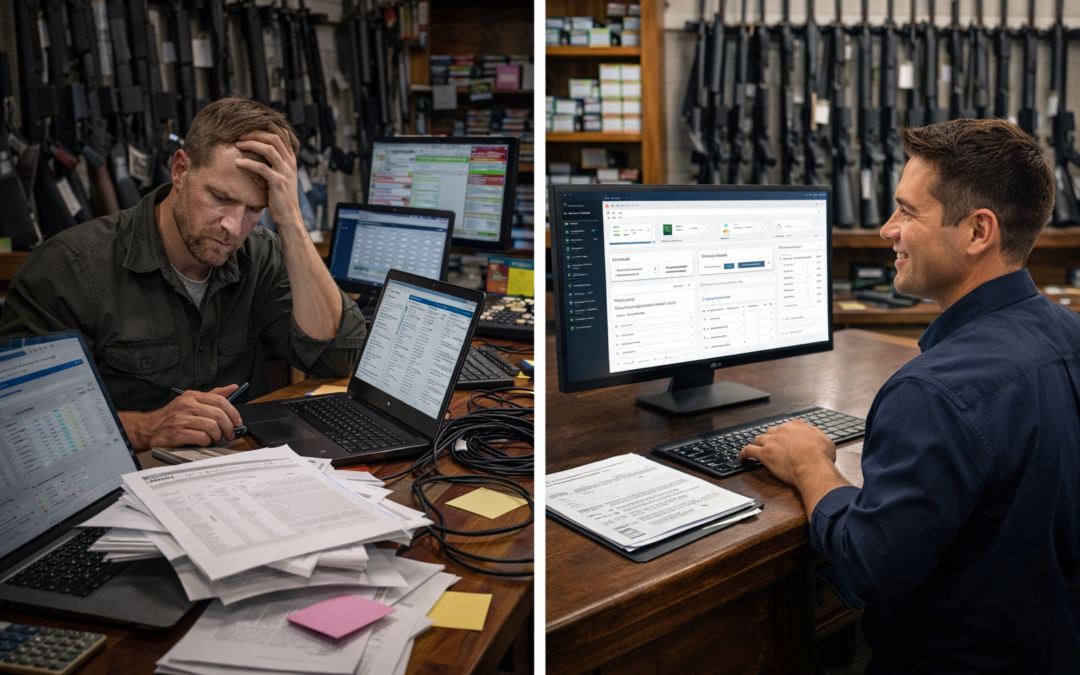
Walk into most gun shops and ask the owner how many software systems they use. The answer is usually somewhere between three and six. One for point of sale. One for accounting. A separate tool for gunsmithing jobs and yet another for range management.
Each one was a reasonable choice on its own. But together, they create a patchwork operation where the same data gets entered multiple times, nothing talks to anything else, and the owner is the only person who knows how it all connects.
According to a Zapier survey of small and mid-sized businesses, 76 percent of workers spend one to three hours a day just moving data between systems. For FFL retailers, where compliance accuracy is not optional, that inefficiency carries more than just a time cost. It carries risk.
What Disconnected Systems Actually Cost You
When your POS does not talk to your bound book, every sale requires a separate compliance entry. When your financial reporting lives in different software than your sales data, month-end close means hours of reconciliation. When your range system is disconnected from retail, you have no unified view of the customer.
The most dangerous cost is the compliance gap. A transaction completed in one system but not properly recorded in another is a finding waiting to happen. That gap does not show up until an inspector finds it.
What Integrated Operations Look Like
An integrated platform is not about having fewer logins. It is about what happens when data flows through the business without friction.
When a sale is processed, the bound book updates automatically. The 4473 pulls firearm details directly from inventory. The disposition is recorded as part of the transaction, not as a separate step someone has to remember.
When POS, payments, and accounting share the same platform, revenue and margin data are current at all times. Month-end close becomes a review, not a reconstruction project. You trust one set of numbers because there is only one set.
When range scheduling, retail, and gunsmithing share the same customer record, a range member who also buys firearms and uses the gunsmithing shop is one customer in the system, not three entries in three databases.
What Changes Day to Day
New employees learn one system instead of five. Inventory accuracy improves because there is one source of truth. Compliance posture strengthens because documentation is built into the workflow. Reporting becomes useful because data does not have to be manually assembled before you can make a decision.
And the owner stops being the integration layer. In too many shops, the owner is the one who knows which system has the right number and how to reconcile conflicting reports. That works until they take a vacation, get sick, or try to step back. A single platform removes the owner as the bottleneck.
The Switching Question
If consolidation is clearly better, why do so many shops stay with patchwork systems? Usually it is fear of the transition. Migrating data and retraining staff feels like a bigger risk than living with the current setup.
But the math changes when you weigh a one-time switch against the ongoing, compounding cost of daily double entry, monthly reconciliation headaches, compliance gaps that quietly accumulate, and the hours spent each week keeping everything loosely stitched together.
The question is not whether switching is disruptive. It is whether staying put is more disruptive in the long run.
AIM consolidates POS, compliance, financials, range management, and gunsmithing on one native platform built by one team. No bolt-on partnerships. No patchwork. One system that runs your entire operation.